

· AFX Research
When the Marital Home Sits Under a Conservation Easement
A recorded conservation easement extinguishes development rights permanently, caps what the property is worth, and gives a third party approval rights over what either spouse can do with it.
Table of Contents
Conservation easements turn up more often than people expect on rural and semi-rural homes, and they change a property settlement in ways that are easy to miss until somebody tries to sell. The instrument is recorded, it binds the land rather than the owner, and it is usually permanent. If one is in the chain, it has to be read before the house is priced.
What the easement fixes in place
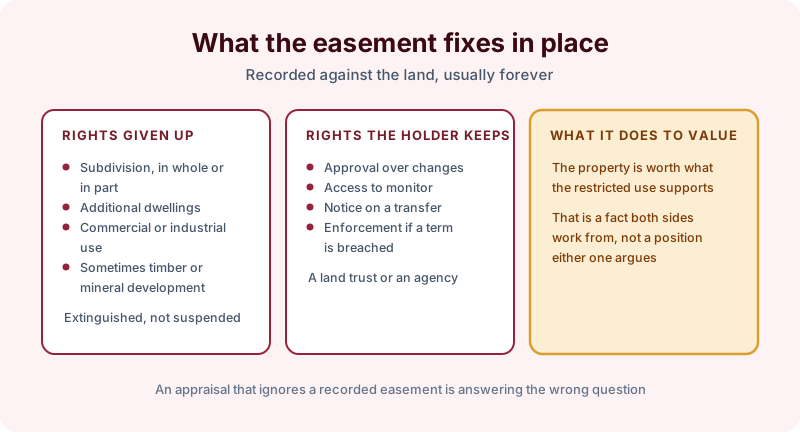
A conservation easement is a conveyance. The owner gave away a defined set of rights — typically to subdivide, to build additional dwellings, to develop commercially, and sometimes to harvest timber or extract minerals — and a land trust or a government agency took them.
Those rights are extinguished rather than suspended. Nothing in a divorce decree restores them, and neither party can convey what the family no longer owns.
The holder keeps more than a passive interest. Most easements reserve approval rights over changes, access to monitor the property annually, a right to notice when title transfers, and the standing to enforce if a term is breached. That makes a third party a participant in what the two parties are negotiating, which is unusual and worth telling a client early.
Where the file actually lives
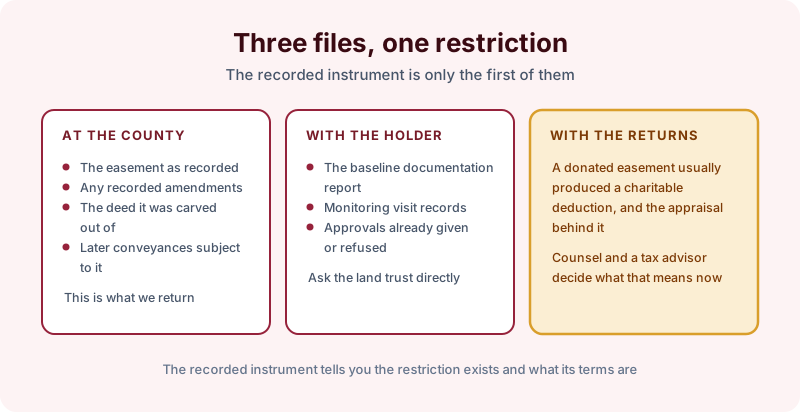
The county holds the recorded easement, any recorded amendments, the deed it was carved out of, and the conveyances that followed subject to it. That is what a search returns, with copies, and reading back far enough to reach the grant is the scoping question our note on marital versus separate property title searches takes up.
The holder keeps everything else. The baseline documentation report describing the property’s condition when the easement was granted, the monitoring visit records, and the history of approvals given or refused are in the land trust’s file and nowhere else. Anybody evaluating what the easement actually permits needs that file, and it is obtained by asking.
There is a third place to look, and it matters in a divorce more than in an ordinary sale. A donated easement commonly produced a substantial charitable deduction, supported by an appraisal, and whether any of that carries a continuing consequence is a question for counsel and a tax advisor.
The effect on value is a fact, not a position
This is the point that saves the most argument. The property is worth what the restricted use supports, and an appraisal that ignores a recorded easement has answered a different question about a different parcel.
Both sides work from the same restriction. What they can legitimately disagree about is what the restricted value is, which is an appraisal question, and the related confusion between the record and valuation generally is covered in property tax records in a divorce title search.
Working it into the settlement
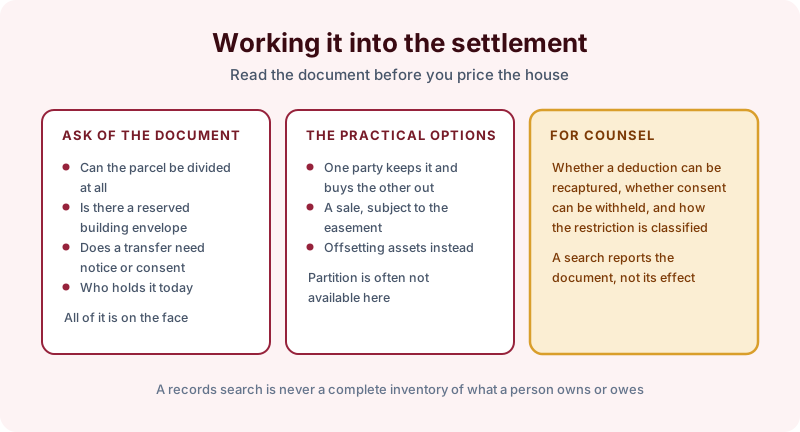
Ask the document four things. Can the parcel be divided at all, or is subdivision barred outright? Is there a reserved building envelope, and has it been used? Does a transfer require notice to the holder, or its consent? And who holds the easement today, since land trusts merge and assign.
Those answers narrow the options quickly. Where subdivision is barred, a court ordered split of the land is not available even if it would otherwise be the obvious remedy, which changes the analysis described in partition and court ordered sale of the marital home. What remains is usually a buyout, a sale subject to the easement, or an offset against other assets.
Whether consent can be withheld, whether a deduction is exposed to recapture, and how the restriction is classified as between marital and separate property are legal conclusions for counsel. We report the recorded documents and attach copies.
The takeaway
A records search reports what was recorded and found in the indexes reviewed, over the term searched, in the county where the property sits. It is not a complete inventory of what either party owns or owes, an empty result does not prove a parcel is unrestricted, and recording and indexing practice varies by county. Start the order online, or send us the address and the county and we will tell you what a search of that scope would and would not cover before anything is ordered.