

· AFX Research
Out-of-State Property in a Divorce: Which Counties Get Searched
Why there is no national land index, the clues that name a county worth checking, how deep to search each parcel, and what an empty result in one county actually proves.
Table of Contents
The single most common gap in a divorce property search is not a hidden entity or a backdated deed. It is a county nobody named. Land records in the United States are kept locally, so a search reaches exactly the offices it is run in and no further, and a parcel three states away is invisible to a thorough search of the county where the couple lives. The question of marital versus separate property comes later. First you have to find the parcel.
No national index exists
There is no federal registry of who owns what real estate. Records are recorded and indexed at the county level, or in some states at the town or parish level, and each of those offices maintains its own index with its own conventions.
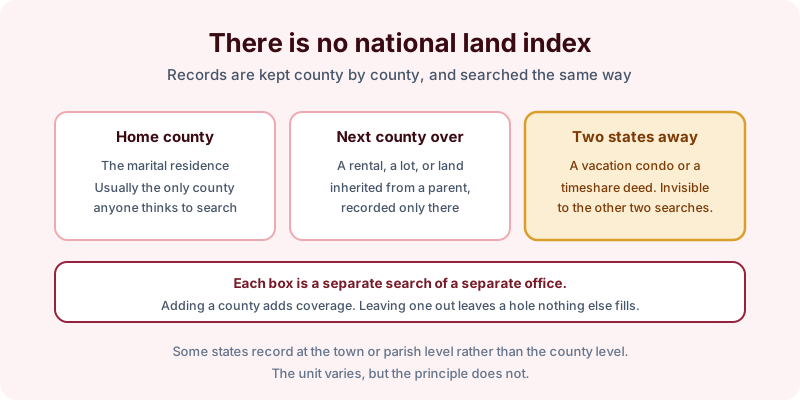
The practical consequence shapes everything else. Coverage is a list of counties, decided before the work begins. Adding a county adds coverage. Leaving one out leaves a hole that no amount of care in the other counties fills, and the report will be accurate and complete about the counties it covered while saying nothing at all about the one it did not.
The commercial databases that claim national coverage are aggregations of what individual counties have published electronically. Coverage is uneven, older records are frequently absent, and some counties publish nothing. They are a reasonable place to generate a lead. They are not a substitute for a search of the county record itself.
Clues that name a county
Since the search needs a county, the useful work upstream is figuring out which counties to name.
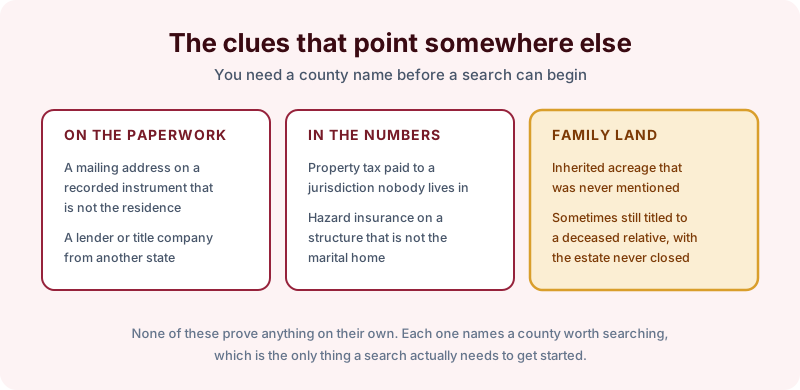
Recorded instruments carry mailing addresses, and an address that is not the marital residence is a lead. So is a lender or title company from a state neither spouse has lived in. Financial records point the same way: property tax paid to a jurisdiction where nobody lives, or hazard insurance on a structure that is not the family home.
Inherited land deserves its own mention because it behaves differently. Family acreage often sits in the county where a parent lived, sometimes still titled in the name of a relative who died years ago with the estate never fully settled. Nobody hid it. It simply never came up, and it will never appear in a search of the marital county.
None of these clues prove anything by themselves. Each one names a county, which is all a search needs to start.
How deep to go on each parcel
Once you have the counties, the second decision is scope, and it does not have to be the same for every parcel.
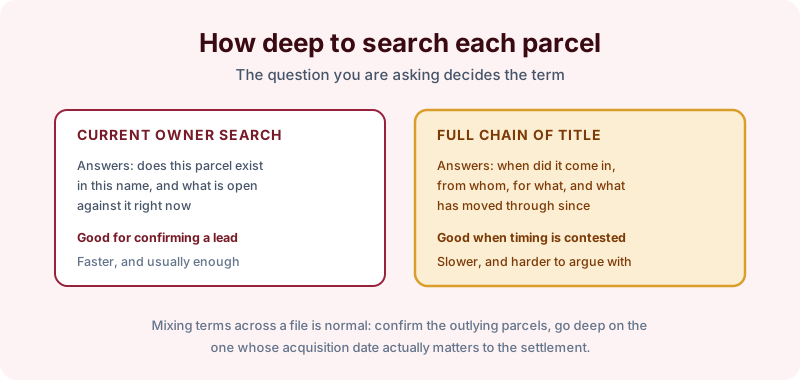
A current owner search answers the confirming question: does a parcel exist in this name in this county, and what is open against it today. That is usually enough for the outlying properties, and it is faster. A full chain of title answers the timing question: when the property came in, from whom, and what has moved through since. That is the one to order where the acquisition date is genuinely contested, since the recorded chain is considerably harder to argue with than a recollection. Our products page sets out the terms available.
Mixing scopes across one file is normal practice rather than a compromise.
Reading a result honestly
An empty result in a county is a real finding, and it is a narrow one. It means no instrument was found of record in that county, under the names searched, on the date searched. It does not establish that a spouse owns nothing there, because indexing practice varies, names get recorded with variants, and property held by an entity is indexed under the entity. Where an entity or trust may be involved, that search runs differently.
Say it that way in a settlement conference. A report that is described precisely holds up. One that gets stretched into “we proved there is nothing” does not, and the stretch is rarely the abstractor’s doing.
The takeaway
Build the county list first, use the paperwork to name counties rather than to draw conclusions, match the depth to what is actually disputed, and describe empty results in the terms the record supports. Start the order online, or send us the names and the counties you are considering and we will tell you what a search of that scope would and would not cover before anything is ordered.