

· AFX Research
A Marital Home in a Historic District, What the Record Shows
Which historic limits are recorded against the parcel, which live in a city ordinance or a commission file, and what each one means for a buyout or a sale.
Table of Contents
A home in a historic district carries obligations that outlast a marriage, and the frustrating part for everyone involved is that most of them are not written in the deed. A title search tells you what was recorded against the parcel. It does not tell you whether the city will let you replace the windows. Both answers matter in a settlement, and they come from different places. The same split appears with an unpermitted addition, where the record and the building file disagree about what the house is.
What a designation can leave in the land record
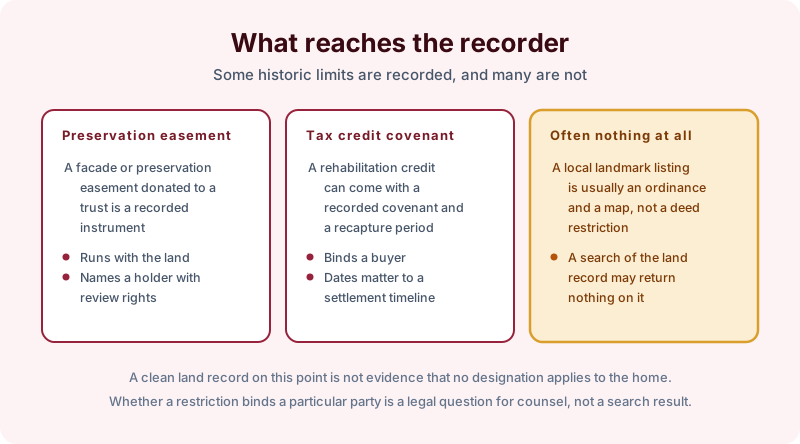
Two instruments show up regularly. A preservation or facade easement, usually donated to a preservation trust in exchange for a charitable deduction, is a recorded grant that gives a named holder the right to review changes to the exterior. It runs with the land and it does not expire when the owners divorce.
A rehabilitation tax credit covenant is the second. Where a credit was claimed for restoration work, the program may require a recorded covenant and a recapture period during which a disqualifying change or, in some programs, a transfer of the property can trigger repayment. The dates on that document belong in the settlement timeline rather than in a footnote.
Beyond those, you may find a subdivision declaration from a planned historic development, or an easement granted to a local authority. A search reports what it finds of record, which is the useful and limited thing it can say.
Where the limits actually live
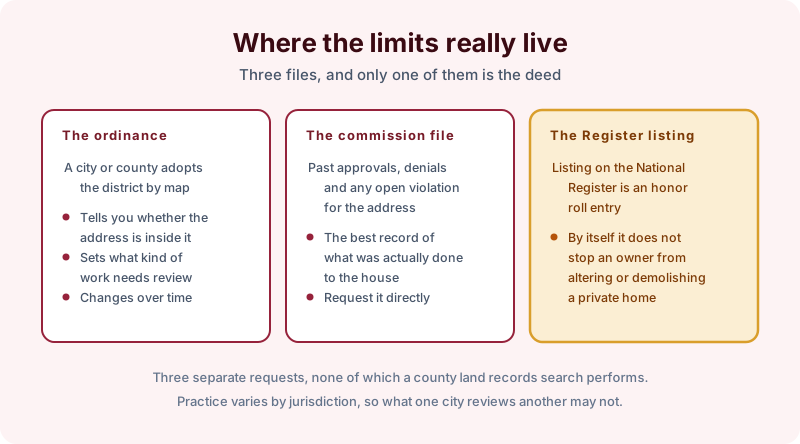
Most local historic districts are created by ordinance and a map, not by a deed restriction on each house. That is why a clean land record on this point proves nothing at all about whether the home sits inside a district.
Three requests fill the gap, and none of them is a title search. The ordinance and district map tell you whether the address is inside the boundary and what kind of work triggers review. The preservation commission file for the address holds past approvals, past denials, and any open violation, and it is usually the best single record of what has actually been done to the house. A National Register listing, which people often assume is the binding one, generally imposes nothing on a private owner acting without federal money or federal permits.
Practice varies by jurisdiction. One city reviews paint colors and another reviews only demolition, so a general answer is worth very little here. The boundary matters more than people expect, because districts are drawn street by street and a house across the road can sit outside it entirely.
What it changes in a settlement
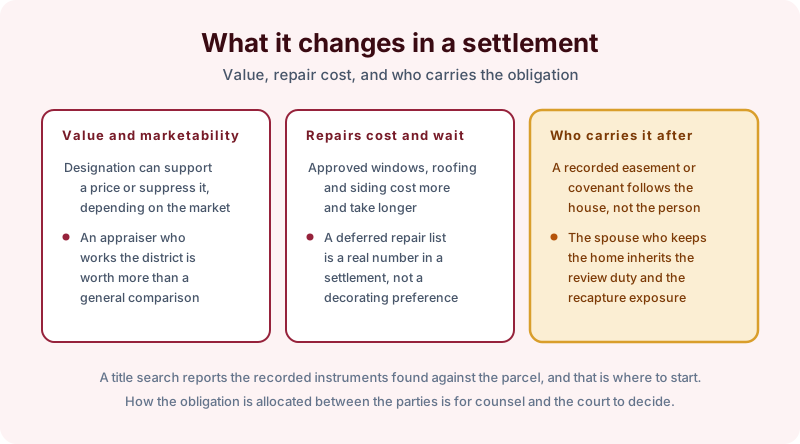
Three practical effects tend to drive the negotiation. Designation moves value in either direction depending on the market, so an appraiser who works inside that district is worth more than a general comparison. Approved repairs cost more and take longer, which turns a deferred maintenance list into a real number rather than a decorating preference. And the recorded obligations follow the house, so whichever spouse keeps it inherits the review duty, the holder’s inspection rights, and any recapture exposure that is still running.
None of that is a legal conclusion, and the characterization of the property and the allocation of these burdens belong to counsel and to the court. What the search contributes is the recorded instrument itself, with the document attached, so nobody is arguing from memory. Our process page describes how that comes back.
The takeaway
Order the title search for what is recorded, and treat the ordinance and the commission file as two separate requests you make yourself. A home under a conservation easement raises the same structure of question with a different holder. Start the order online, or send us the address and the county and we will tell you what a search of that scope would and would not cover before anything is ordered.