

· AFX Research
Municipal and Utility Charges on the Marital Home in a Divorce
Unpaid water and sewer, code enforcement and abatement charges, and stormwater fees, which of them attach to the parcel in a divorce, and what a title search will and will not find.
Table of Contents
Most of the debt in a divorce follows a person. Credit cards, medical bills, and personal loans belong to whoever signed, and dividing them is a question of who pays what. A smaller category behaves differently. Unpaid water, sewer, code enforcement, and abatement charges frequently attach to the parcel itself, which means they follow the house to whichever spouse keeps it, no matter what the decree says between the parties.
Two kinds of debt, and only one of them is about the house
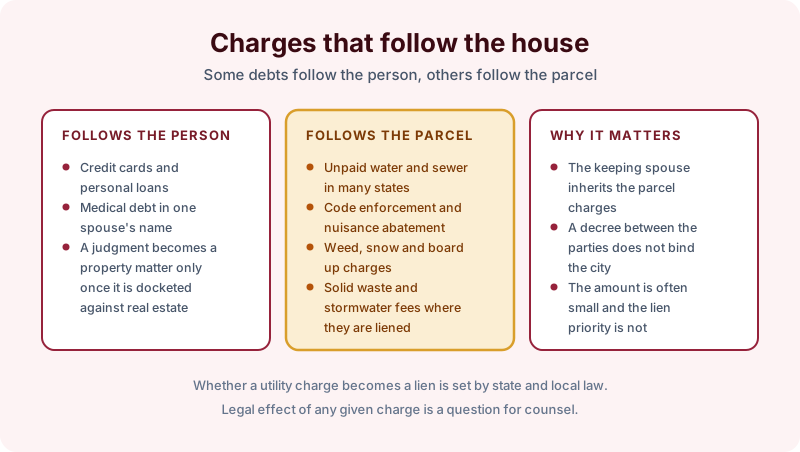
A city does not care which spouse ran the water. In many states an unpaid utility balance is a charge against the service address, enforceable against the property regardless of who held the account. Code enforcement works the same way. If the city mowed the yard, boarded a window, removed a derelict vehicle, or abated a nuisance, the cost of that work is typically charged to the parcel.
The amounts tend to be modest, which is why they get overlooked. The priority does not. In a number of jurisdictions a municipal charge sits ahead of a recorded mortgage, which makes a three-hundred-dollar weed-cutting bill a problem out of proportion to its size.
Three ways the charge reaches the record
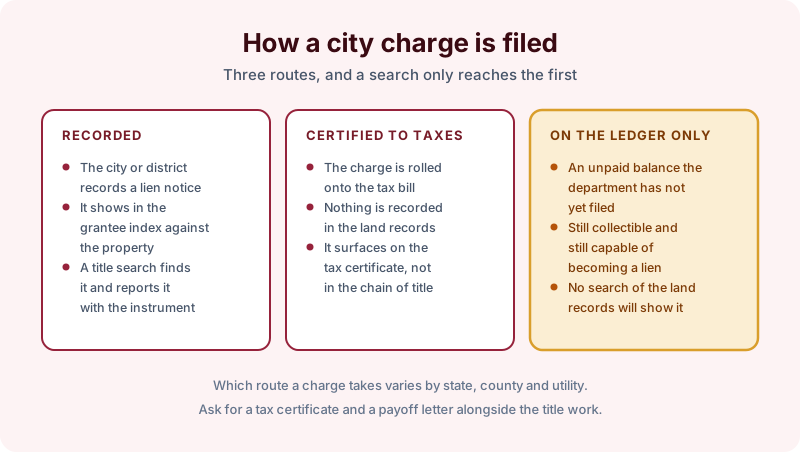
Recorded. The city or district records a lien notice against the property. It appears in the index, a title search finds it, and the instrument can be pulled and read.
Certified to the tax roll. The charge is added to the annual property tax bill and nothing is recorded in the land records at all. It is just as collectible, and it surfaces on a tax certificate rather than in the chain of title.
On the department ledger. The balance exists, the department has not filed anything yet, and no search of the land records will show it. This is the one that catches people at closing.
Which route a given charge takes is set by state statute and local ordinance, and it varies between neighboring counties. Never assume that the practice in one jurisdiction describes the one next door.
What the search returns
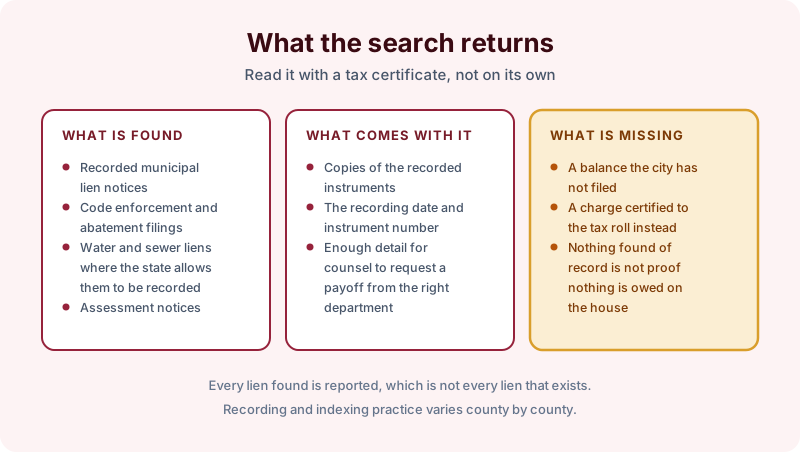
The report lists the recorded municipal liens, code enforcement filings, abatement charges, and assessment notices found of record against the property over the term searched, with copies of the instruments, the recording dates, and the instrument numbers. That last detail matters practically, because it tells counsel which department to write to for a payoff figure.
What it cannot do is report an unfiled balance or a charge sitting on the tax roll. Nothing found of record is not proof nothing is owed on the house. Pairing the search with a tax certificate and, where a balance is suspected, a direct payoff request to the water department, is how the gap gets closed. Our search products list what each term covers.
Settling it rather than inheriting it
A decree can allocate these charges between the spouses, and it should. What it cannot do is release the parcel. If the agreement is that one spouse keeps the house, the practical step is to establish the full set of charges before the equity figure is fixed, get payoff letters, and have the payoffs funded through the closing or the refinance rather than left as a promise.
The same reasoning applies to hoa liens and assessments, which attach to the unit in much the same way, and to tax liens on marital property, which sit at the top of the priority order almost everywhere.
Legal effect is a question for counsel in that state. The abstractor’s job is to put the recorded instruments on the table, not to rank them.
The takeaway
Ask specifically about municipal and utility charges rather than assuming a lien search covers them. Request the recorded instruments, pull a tax certificate for the charges that never get recorded, and write to the department for anything still sitting unfiled on a ledger.
Start the order online, or send us the names and addresses and we will tell you what a search of that scope would and would not cover before anything is ordered.