

· AFX Research
A Marital Home That Was Operating as a Short Term Rental
What a short term rental leaves in the public record, which restrictions follow the house to the next owner, and why a permit in one name says nothing about who owns it.
Table of Contents
A house that has been earning on a nightly booking platform behaves like two assets at once in a property settlement. There is the real estate, which divides the way real estate always divides, and there is an operating permission that may be worth more than the furniture and may not survive the divorce at all. Treating the second as though it travels with the deed is the common mistake, and it is a different mistake from the one in our note on a marital home with a business run from it, where the business is usually separable from the structure.
Where the paper trail actually sits
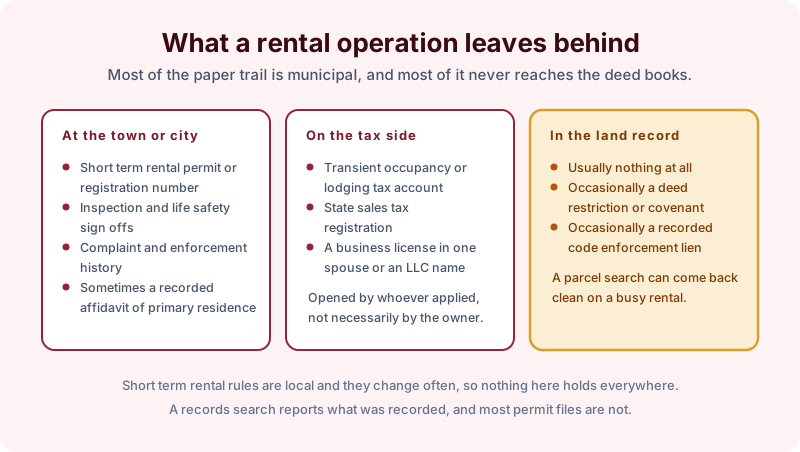
Almost all of it is municipal. A permit or registration number, inspection sign-offs, a life safety certificate, and in many towns a complaint and enforcement history sit in a file at the city or county planning office. Beside that are tax accounts — a transient occupancy or lodging tax registration, a state sales tax number, sometimes a business license held by an LLC that one spouse formed and the other has never seen.
What does not sit in the land records is most of that. A parcel search on a house that has hosted four hundred guests can come back showing a deed, a mortgage and nothing else, because none of the operating apparatus was ever recorded against the property. That is not a defect in the search. It is a fact about where these files live, and it is why the scope conversation matters before the order rather than after.
Which restrictions follow the house
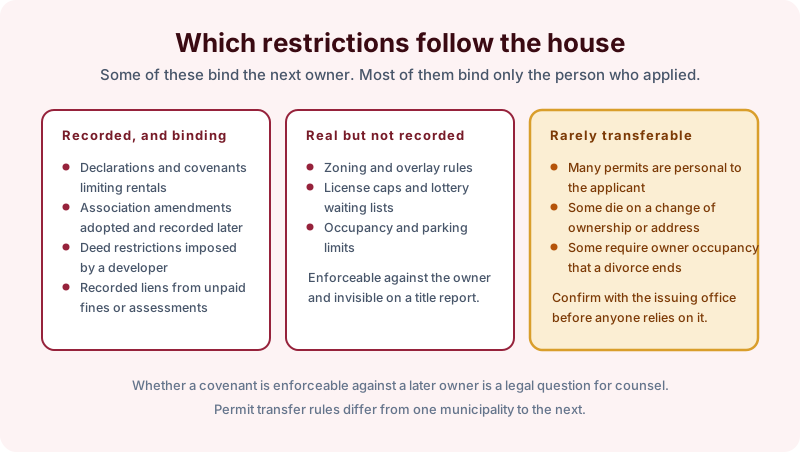
Here the record does carry weight. A declaration of covenants that limits or bans rentals under thirty days binds whoever owns the unit, and an association that amended its rules three years ago and recorded the amendment has created an encumbrance that a buyer inherits. Unpaid fines reduced to a recorded lien behave the same way, which is the territory our note on HOA liens and assessments in a divorce covers in more detail.
Zoning is different. An overlay district that caps licenses, a parking requirement, an occupancy limit — all real, all enforceable, none of it recorded against the parcel and none of it visible on a title report.
Permits themselves are the sharpest edge. Many are personal to the applicant and do not transfer on sale. Some require owner occupancy, which a decree awarding the house to one spouse can quietly terminate. Confirm the rule with the office that issued the permit before either party values the house on the assumption that the income continues.
What a search of this house returns
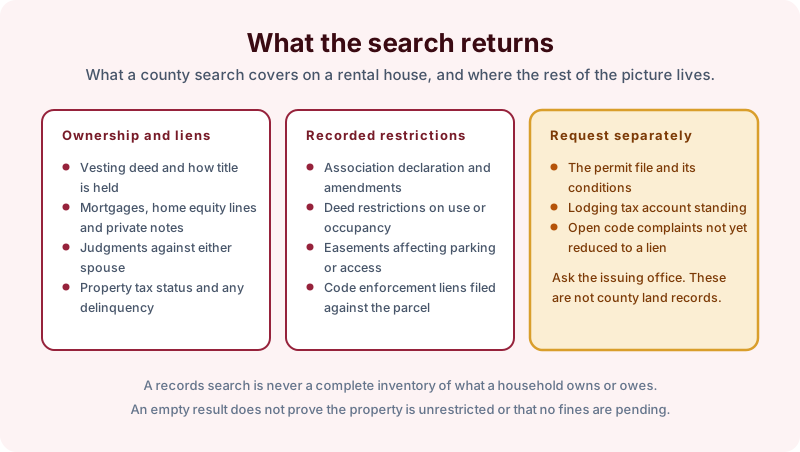
The county gives you the vesting deed and how title is held, mortgages and home equity lines, judgments against either spouse, tax status, the association declaration and its amendments, use restrictions, access easements, and any code enforcement lien filed against the parcel. That is a real picture of the encumbrances, and on a property that also generates rental income it pairs naturally with the work described in a rental property divorce title search.
What it is not is a complete inventory. Recording practice varies by county, enforcement files are not land records, and an empty result does not prove the property is unrestricted or that no fine is pending. We report what was found of record over the term searched and say plainly what sits outside it.
The takeaway
Separate the two questions early. Who owns the real estate is answerable from the record, and a search answers it. Whether the operating permission survives the decree is a question for the issuing municipality and for counsel, and nobody should value the house as though the answer is already yes. Start the order online, or send us the address and both names and we will tell you what a search of that scope would and would not cover before anything is ordered.